
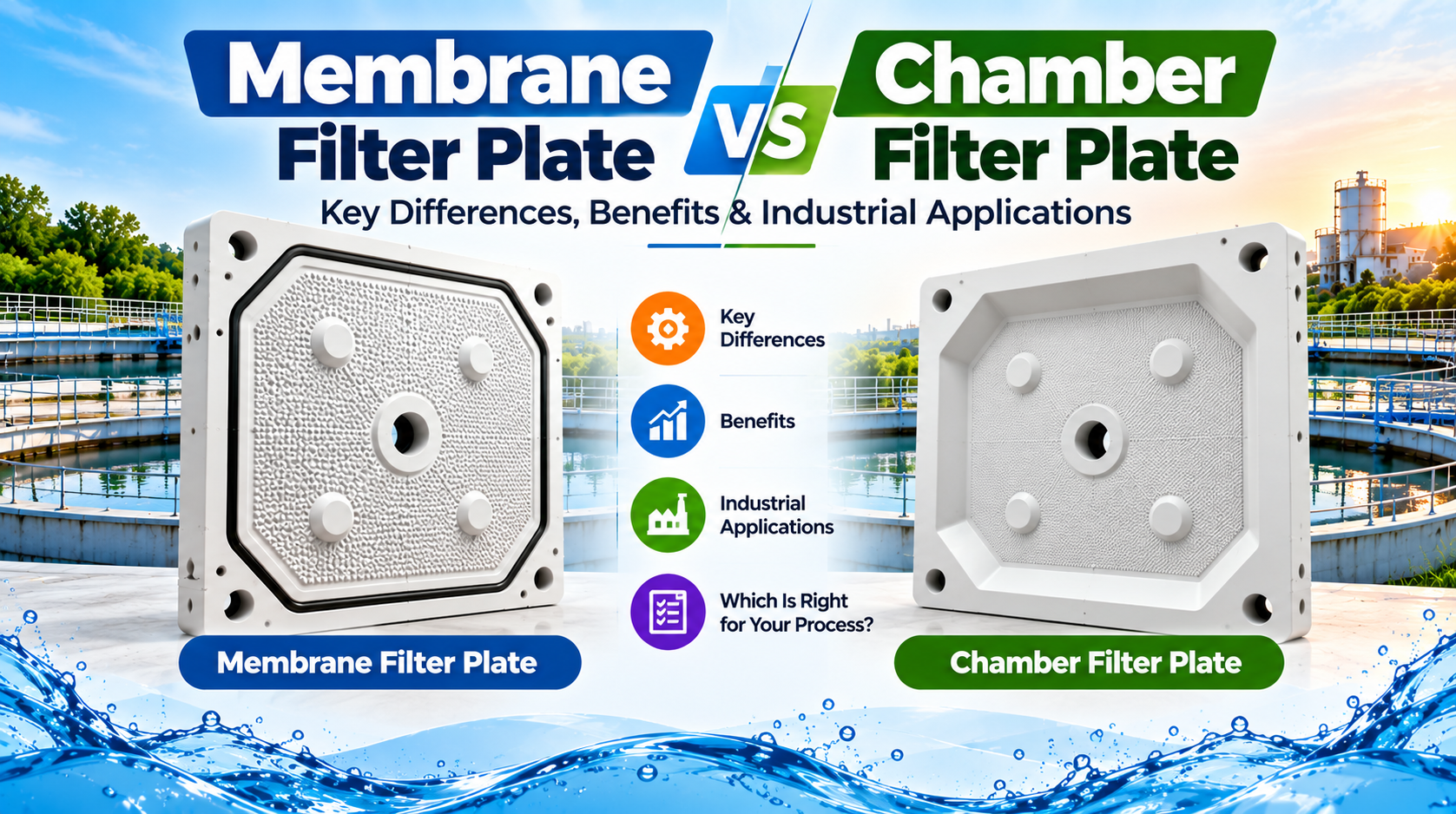
Membrane Filter Plate vs Chamber Filter Plate: Key Differences, Benefits & Industrial Applications
Choosing the right filter plate can make a significant difference in industrial filtration efficiency, operating costs, filter cake moisture, and overall equipment performance. When comparing a Membrane Filter Plate vs Chamber Filter Plate, understanding how each technology works is essential for selecting the right solution for your filtration process.
Both membrane filter plates and chamber filter plates are widely used in filter press systems for solid-liquid separation. However, they differ in design, filtration methods, operating requirements, and the level of cake dryness they can achieve.
A chamber filter plate relies primarily on feed pressure to separate solids from liquids, while a membrane filter plate adds a secondary squeezing stage that can remove additional liquid from the filter cake.
For industries handling wastewater sludge, chemicals, minerals, pigments, and other industrial slurries, selecting the appropriate filter plate can influence productivity, energy consumption, maintenance, and long-term operating expenses.
This guide explains the key differences between membrane and chamber filter plates, their working principles, advantages, limitations, industrial applications, and important factors to consider before purchasing.
What Is a Membrane Filter Plate?
A membrane filter plate is a specialized filter press component designed to improve solid-liquid separation by applying additional mechanical pressure to the filter cake after the initial filtration stage.
Unlike conventional chamber filter plates, membrane plates incorporate a flexible diaphragm or membrane that expands when pressurized with an appropriate squeezing medium, such as water or compressed air.
This expansion compresses the accumulated filter cake, forcing additional liquid through the filter cloth and into the filtrate collection system.
How Does a Membrane Filter Plate Work?
A membrane filter plate operates through two main stages: primary filtration and secondary cake squeezing.
Step 1: Slurry Feeding
Industrial slurry is pumped into the filter press chambers under controlled pressure.
Step 2: Primary Filtration
Liquid passes through the filter cloth while suspended solids accumulate inside the filtration chambers.
Step 3: Filter Cake Formation
As filtration continues, the retained solids form a filter cake between the plates.
Step 4: Membrane Squeezing
After the feed stage, a squeezing medium is introduced behind the flexible membrane. The membrane expands and compresses the cake.
Step 5: Additional Liquid Removal
The applied compression displaces additional liquid from the cake, which passes through the filter media.
Step 6: Cake Discharge
After the squeezing pressure is safely released, the filter press opens and the dewatered cake is discharged.
Key Benefits of Membrane Filter Plates
- Lower filter cake moisture: Secondary squeezing can improve cake dryness compared with feed-pressure filtration alone.
- Potentially shorter filtration cycles: Optimized squeezing can reduce the time needed to achieve a target cake moisture level.
- Reduced downstream drying requirements: Drier cake may require less thermal drying or other post-processing.
- Lower waste handling costs: Reduced moisture can decrease the mass of wet cake requiring transport or disposal.
- Improved process control: Operators can adjust squeezing pressure and duration according to slurry characteristics.
- Suitable for demanding applications: Membrane filtration is particularly useful when achieving low residual moisture is important.
The actual improvement depends on cake compressibility, particle size distribution, filtration pressure, filter cloth selection, and operating conditions.
For more information about industrial filtration components, explore the filter press solutions available from Filter Press Panama.
What Is a Chamber Filter Plate?
A chamber filter plate, commonly known as a recessed chamber filter plate, is a conventional filter press component used to separate suspended solids from liquids.
Each plate contains a recessed area. When multiple plates are compressed together, the recesses form chambers where solids accumulate during filtration.
Chamber filter plates typically use rigid polypropylene or other suitable materials and do not require a separate membrane squeezing stage.
How Does a Chamber Filter Plate Work?
The chamber filter plate works through pressure-driven filtration.
Step 1: Plate Closing
The filter press closes, securing the plates together and forming sealed filtration chambers.
Step 2: Slurry Introduction
A feed pump transfers slurry into the chambers.
Step 3: Liquid Separation
The pressure difference across the filter cloth drives liquid through the filtration media.
Step 4: Cake Formation
Suspended solids accumulate within the recessed chambers.
Step 5: Filtration Completion
The filtration cycle ends when the desired endpoint is reached, such as a specified filtration time, filtrate flow rate, or chamber filling condition.
Step 6: Cake Discharge
The press opens and the accumulated cake is removed.
Key Benefits of Chamber Filter Plates
- Simple construction: Rigid plate design supports straightforward operation.
- Lower initial equipment cost: Conventional chamber systems are often less expensive than comparable membrane systems.
- Fewer specialized components: No inflatable squeezing membrane is required.
- Straightforward maintenance: Fewer squeezing-related components can simplify routine maintenance.
- Reliable filtration: Suitable for many established industrial solid-liquid separation processes.
- Broad application range: Commonly used in chemical processing, wastewater treatment, mining, and manufacturing.
Chamber filter plates are particularly suitable when standard cake dryness is acceptable and minimizing initial investment is a priority.
Membrane Filter Plate vs Chamber Filter Plate: Key Differences
The primary difference between a membrane filter plate and a chamber filter plate is the way pressure is applied to remove liquid from the filter cake.
A chamber filter plate relies mainly on feed pressure, whereas a membrane filter plate provides additional mechanical squeezing after primary filtration.
Detailed Comparison Table
Feature
Membrane Filter Plate
Chamber Filter Plate
Plate construction
Incorporates a flexible squeezing membrane
Rigid recessed plate
Filtration method
Primary filtration followed by membrane squeezing
Primarily feed-pressure filtration
Cake dryness
Can achieve lower residual moisture
Depends on feed pressure and slurry properties
Secondary squeezing
Available
Not available
Initial investment
Generally higher
Generally lower
Operating complexity
Requires squeezing controls and associated equipment
Relatively straightforward
Maintenance
Membrane inspection and squeezing-system maintenance
Plate, seal, and cloth maintenance
Cycle time
May be shorter for a given dryness target
Depends on slurry and filtration endpoint
Energy requirements
Includes energy for squeezing medium
Mainly feeding and press operation
Cake handling
Potentially lighter and drier cake
May produce wetter cake
Suitable applications
Moisture-sensitive or demanding dewatering operations
General-purpose solid-liquid separation
Main advantage
Additional cake dewatering
Simpler and often more economical operation
Neither plate type is universally better. The appropriate choice depends on the required filtration outcome and total operating costs.
1. Difference in Filtration Technology
The most important distinction between membrane and chamber filter plates is the filtration mechanism.
Membrane Filter Plate Technology
Membrane filter plates combine conventional pressure filtration with an additional mechanical squeezing stage.
Once the cake has formed, the membrane expands and applies pressure directly to the cake.
This helps remove liquid that remains within the filter cake after the initial filtration stage.
Membrane squeezing is particularly useful for cakes that respond well to mechanical compression.
Chamber Filter Plate Technology
Chamber filter plates use the pressure supplied by the slurry feed pump to drive liquid through the filter cloth.
As solids accumulate, the growing cake creates additional resistance to liquid flow.
Filtration becomes progressively slower as cake thickness and resistance increase.
Because there is no secondary membrane squeezing stage, further dewatering generally depends on the filtration conditions and the characteristics of the cake.
2. Difference in Filter Cake Moisture
Filter cake moisture is one of the most important performance indicators in industrial dewatering.
It influences cake weight, transportation requirements, disposal costs, downstream processing, and material recovery.
Membrane Filter Plate Cake Moisture
Membrane squeezing can reduce residual cake moisture by compressing the solids after primary filtration.
This is beneficial when:
- Waste disposal costs depend on wet cake weight.
- Downstream drying consumes substantial energy.
- Recovered solids require lower moisture levels.
- Storage and handling become difficult with wet material.
- Production processes require more consistent cake characteristics.
However, membrane squeezing does not guarantee a particular moisture percentage.
Chamber Filter Plate Cake Moisture
Chamber filter plates can produce adequately dewatered cakes in many applications.
Their performance depends on feed pressure, slurry concentration, filtration time, particle characteristics, and filter media.
For processes where the resulting cake already meets handling or disposal requirements, a chamber filter plate may provide the more economical solution.
How Is Filter Cake Moisture Calculated?
Filter cake moisture is commonly expressed as the percentage of water in the total wet cake mass.
Moisture Content (%) = (Mass of Water ÷ Total Wet Cake Mass) × 100
For example, if a wet filter cake weighs 100 kg and contains 30 kg of water, its moisture content is 30%.
Reducing moisture content can have a meaningful effect on waste transport and disposal costs.
3. Difference in Filtration Cycle Time
Filtration cycle time directly affects the amount of slurry a filter press can process over a working shift.
Membrane Filter Plate Cycle Time
Membrane filter plates may shorten the overall cycle needed to achieve a specific cake dryness.
Instead of extending the feed-filtration stage to remove small amounts of additional liquid, operators can use membrane squeezing after suitable cake formation.
However, the squeezing, depressurization, and discharge stages also require time.
The total cycle must be evaluated rather than assuming that membrane filtration is always faster.
Chamber Filter Plate Cycle Time
Chamber filter press cycle time depends primarily on:
- Slurry solids concentration
- Feed pressure
- Particle size and cake permeability
- Filter cloth resistance
- Cake thickness
- Required filtration endpoint
- Plate opening and cake discharge time
For readily filterable slurries, chamber plates can deliver efficient production cycles without additional squeezing equipment.
4. Difference in Equipment Cost and Maintenance
Initial investment and long-term operating expenses are important considerations when selecting industrial filtration equipment.
Membrane Filter Plate Cost Considerations
Membrane filtration systems generally require a higher initial investment because of their specialized plate construction and squeezing equipment.
Additional components may include:
- Squeezing-medium supply system
- Pressure regulation equipment
- Membrane control valves
- Safety interlocks
- Pressure monitoring instruments
- Automated squeezing controls
Membranes also require inspection for wear, fatigue, leakage, and chemical compatibility.
Despite higher equipment costs, membrane systems can be economical when reduced cake moisture creates meaningful downstream savings.
Chamber Filter Plate Cost Considerations
Chamber filter plates typically offer lower initial costs and simpler maintenance.
Routine maintenance focuses on:
- Filter cloth inspection and replacement
- Plate surface cleaning
- Seal inspection where applicable
- Feed-port and filtrate-channel cleaning
- Plate alignment and condition
- Hydraulic closing system maintenance
The simpler configuration makes chamber filter plates attractive for many general-purpose industrial filtration applications.
5. Industrial Applications of Membrane Filter Plates
Membrane filter plates are commonly considered where enhanced dewatering provides a practical operational benefit.
Wastewater and Sludge Treatment
Industrial wastewater treatment facilities generate sludge that must be separated from water.
Membrane squeezing can help reduce cake moisture, potentially lowering transport and disposal requirements.
Chemical Processing
Chemical manufacturers use filter presses to separate precipitated solids, pigments, intermediates, and other process materials.
Membrane plates may improve cake dewatering where product specifications require lower residual liquid.
Mining and Mineral Processing
Mineral processing operations frequently require solid-liquid separation for concentrates, tailings, and process slurries.
Membrane filtration can be beneficial when lower cake moisture improves handling, transportation, or material recovery.
Pharmaceutical and Specialty Chemical Processing
Some specialty processing operations require controlled filtration and consistent cake properties.
Plate materials, seals, and filtration media must be selected according to chemical compatibility and process requirements.
Pigment and Dye Manufacturing
Membrane filter plates may be used to dewater pigment and dye cakes before drying or further processing.
6. Industrial Applications of Chamber Filter Plates
Chamber filter plates are widely used across industries that require reliable solid-liquid separation without a separate squeezing stage.
Industrial Wastewater Treatment
Chamber filter presses are used to separate suspended solids from industrial wastewater and treatment sludge.
Chemical Manufacturing
They are suitable for many precipitation, clarification, and solid recovery processes.
Food and Beverage Processing
Where appropriate hygienic design and food-contact materials are used, chamber filter presses can support selected filtration processes.
Mining and Mineral Processing
Chamber plates are used for mineral concentrates, tailings, and other slurries where their dewatering performance meets operational requirements.
Ceramic and Clay Processing
Ceramic manufacturers use filter presses to dewater clay and other mineral suspensions before subsequent production stages.
General Manufacturing
Chamber filter plates can support various industrial processes involving slurry filtration, solids recovery, and liquid clarification.
7. How to Choose Between Membrane and Chamber Filter Plates
Choosing the correct filter plate requires evaluating more than the purchase price.
The following factors should guide the decision.
Consider Your Required Cake Dryness
If the process requires low residual moisture, membrane squeezing may provide an advantage.
If standard pressure filtration produces an acceptable cake, chamber plates may be sufficient.
Evaluate Slurry Characteristics
Consider the slurry's:
- Solids concentration
- Particle size distribution
- Viscosity
- Chemical composition
- Temperature
- Compressibility
- Filtration resistance
Some slurries respond well to membrane squeezing, while others provide limited additional moisture reduction.
Compare Total Operating Costs
Evaluate the total cost of ownership, including:
- Equipment purchase
- Installation
- Energy consumption
- Filter cloth replacement
- Maintenance
- Squeezing-medium requirements
- Labor
- Waste transportation
- Disposal charges
- Downstream drying
A higher initial equipment cost may be justified when operating savings are substantial.
Determine Production Capacity
The required filtration capacity should be evaluated in relation to the complete cycle time.
A system with faster dewatering is not necessarily more productive unless filling, squeezing, opening, and discharge times are also considered.
Check Material Compatibility
Polypropylene and other plate materials must be compatible with the slurry's temperature, chemical composition, and operating conditions.
For membrane systems, diaphragm material compatibility is equally important.
Review Equipment Compatibility
Replacing chamber plates with membrane plates is not always a simple plate-for-plate substitution.
The filter press must support the required plate thickness, chamber arrangement, closing force, feed connections, squeezing system, and operating controls.
Consult the equipment manufacturer before modifying an existing filter press.
8. Can Membrane Filter Plates Replace Chamber Filter Plates?
Yes, membrane filter plates can sometimes replace chamber filter plates in an existing filter press, but compatibility must be verified before installation.
The replacement depends on the filter press design, available plate-pack length, closing mechanism, squeezing-medium connections, and safety controls.
A membrane plate installation may require modifications to the filtration system.
Important checks include:
- Plate dimensions and thickness
- Filter press closing force
- Plate-pack configuration
- Feed and filtrate port alignment
- Squeezing-medium connections
- Maximum permitted operating pressure
- Control and safety arrangements
- Chemical and temperature compatibility
A qualified equipment specialist should assess these requirements before any conversion.
9. Membrane Filter Plate vs Chamber Filter Plate: Which Is More Cost-Effective?
The more cost-effective option depends on the process and the financial value of additional cake dewatering.
A chamber filter plate may be more economical when the filtration process already meets moisture and production requirements.
A membrane filter plate may offer better long-term value when reducing residual cake moisture produces measurable savings.
Example: Comparing Waste Disposal Costs
Consider a hypothetical process producing 1,000 kg of filter cake at 40% moisture.
The cake contains:
- Dry solids: 600 kg
- Water: 400 kg
- Total wet cake: 1,000 kg
If an improved dewatering process reduces the cake moisture to 30%, while retaining the same 600 kg of dry solids:
Final Wet Cake Mass = 600 ÷ (1 − 0.30) = Approximately 857 kg
The resulting reduction in wet cake mass is approximately 143 kg per batch.
That represents a 14.3% reduction in the original wet cake mass.
This example is illustrative, not a guaranteed membrane filter press result. Actual moisture reduction depends on the slurry and operating conditions.
When disposal costs are charged by weight, the potential savings can become significant over repeated production cycles.
10. Common Mistakes When Selecting Filter Press Plates
Industrial buyers sometimes focus only on equipment price without evaluating process performance.
Avoid these common mistakes.
Selecting Plates Based Only on Purchase Price
Lower initial costs do not always mean lower lifetime costs.
Assuming Membrane Plates Always Produce the Driest Cake
Membrane squeezing performance varies by slurry and cake characteristics.
Ignoring Filter Cloth Selection
Filter cloth permeability, material, and particle retention influence filtration efficiency and cake release.
Overlooking Operating Pressure Limits
Exceeding manufacturer-approved pressure limits can damage plates, membranes, or other equipment.
Ignoring Maintenance Requirements
Both membrane and chamber systems require regular inspections and preventive maintenance.
Skipping Filtration Trials
Laboratory or pilot-scale filtration testing can help establish achievable cake moisture, filtration time, and operating requirements before a major equipment investment.
11. Why Filter Plate Quality Matters
The performance of a filter press depends not only on plate type but also on the quality of its components.
Properly manufactured filter plates should provide:
- Accurate dimensions and alignment
- Appropriate mechanical strength
- Chemical compatibility
- Suitable temperature resistance
- Reliable sealing surfaces
- Effective filtrate drainage
- Compatibility with the intended filter cloth
- Consistent performance within rated operating limits
Poor-quality or incompatible plates can contribute to leakage, uneven cake formation, excessive maintenance, and equipment downtime.
When evaluating suppliers, request technical specifications, material details, operating limits, dimensional drawings, and compatibility information.
12. Choosing Filter Press Solutions from Filter Press Panama
Selecting between membrane and chamber filter plates requires a clear understanding of the filtration process, operating conditions, and desired results.
Filter Press Panama provides an online resource for exploring industrial filtration equipment and filter press components.
If you are comparing plate designs or planning a filtration system, begin by identifying your slurry characteristics, required processing capacity, target cake moisture, and equipment configuration.
You can explore the Filter Press Panama website for relevant industrial filtration information.
For product inquiries, plate selection guidance, or compatibility questions, contact Filter Press Panama with your filtration requirements.
Providing detailed operating information helps suppliers recommend a more suitable filtration configuration.
People Also Ask: Membrane Filter Plate vs Chamber Filter Plate
What is the main difference between a membrane filter plate and a chamber filter plate?
A membrane filter plate includes a flexible diaphragm that applies additional pressure to the filter cake after primary filtration. A chamber filter plate relies mainly on slurry feed pressure to separate solids from liquids.
Which filter plate provides better cake dryness?
Membrane filter plates can achieve lower residual cake moisture because of their additional squeezing stage. However, the actual result depends on slurry characteristics, operating pressure, filter cloth selection, and filtration conditions.
Are membrane filter plates more expensive?
Membrane filter plates and their associated squeezing systems generally cost more initially than conventional chamber filter plates. They may nevertheless reduce total operating costs when improved cake dryness lowers disposal or drying expenses.
Can chamber filter plates be used for wastewater treatment?
Yes. Chamber filter plates are widely used for industrial wastewater treatment and sludge dewatering. Their suitability depends on sludge characteristics and the required final cake moisture.
Is a membrane filter press always faster than a chamber filter press?
No. Membrane squeezing may shorten the time required to reach a particular cake dryness, but the complete cycle also includes feeding, squeezing, depressurization, opening, and discharge.
Frequently Asked Questions
1. What is a membrane filter plate used for?
A membrane filter plate is used in filter press systems to improve solid-liquid separation by squeezing additional liquid from the filter cake after primary filtration. It is commonly considered for wastewater treatment, chemical processing, and mineral dewatering.
2. What is a chamber filter plate used for?
A chamber filter plate is used to separate suspended solids from liquids under feed pressure. It forms recessed filtration chambers that collect solids while liquid passes through the filter cloth.
3. Which is better: membrane filter plate or chamber filter plate?
Membrane filter plates are often preferable when lower cake moisture is important. Chamber filter plates are often preferable when simpler operation and lower initial investment are priorities. The best choice depends on the application.
4. What is a recessed chamber filter plate?
A recessed chamber filter plate is a rigid filter press plate with a recessed surface. When plates are assembled together, they create chambers that collect solids during filtration.
5. Can membrane filter plates reduce sludge disposal costs?
Yes, they may reduce disposal costs by lowering the moisture content and wet weight of filter cake. The savings depend on achievable dewatering performance and the applicable waste disposal charges.
6. What materials are used to manufacture filter press plates?
Polypropylene is commonly used because of its chemical resistance and suitability for many industrial filtration applications. Other materials may be selected for specific chemical, temperature, or mechanical requirements.
7. Do membrane filter plates require special maintenance?
Yes. Membrane filter plates require routine inspection of the membranes, sealing surfaces, filter cloths, and squeezing equipment. Maintenance should follow the manufacturer's instructions.
8. Can membrane plates be installed in an existing chamber filter press?
Sometimes. Installation depends on mechanical compatibility, plate dimensions, closing force, squeezing connections, and control systems. Manufacturer approval is recommended before conversion.
9. How can filter press cycle time be reduced?
Cycle time may be improved through suitable slurry conditioning, correct filter cloth selection, optimized feed pressure, appropriate plate configuration, and efficient cake discharge. Membrane squeezing may also help in certain applications.
10. How do I choose the right filter press plate supplier?
Choose a supplier that can provide accurate technical specifications, compatible materials, suitable plate dimensions, clear operating limits, and application-specific guidance. Filtration testing is valuable for demanding applications.
Conclusion
Understanding the differences between a Membrane Filter Plate vs Chamber Filter Plate is essential for making an informed industrial filtration investment.
Membrane filter plates provide an additional squeezing stage that can improve filter cake dryness, reduce wet cake handling requirements, and potentially lower downstream processing costs.
Chamber filter plates offer a simpler, established filtration solution with generally lower initial equipment costs and straightforward maintenance requirements.
The right choice depends on slurry properties, required cake moisture, production capacity, equipment compatibility, and overall operating economics.
Rather than choosing solely on initial purchase price, evaluate the complete filtration process and the long-term cost of achieving your required results.
Looking for a suitable filter press plate for your industrial application?
Visit Filter Press Panama to explore industrial filtration information, or contact the Filter Press Panama team to discuss your slurry characteristics, filtration capacity, and plate requirements.
Selecting the right filter plate is an important step toward reliable, efficient, and cost-effective solid-liquid separation.
Explore Filter Press Solutions
Continue your research with our filter press machines, filter press plates and technical enquiry pages.
Send Your Requirement