
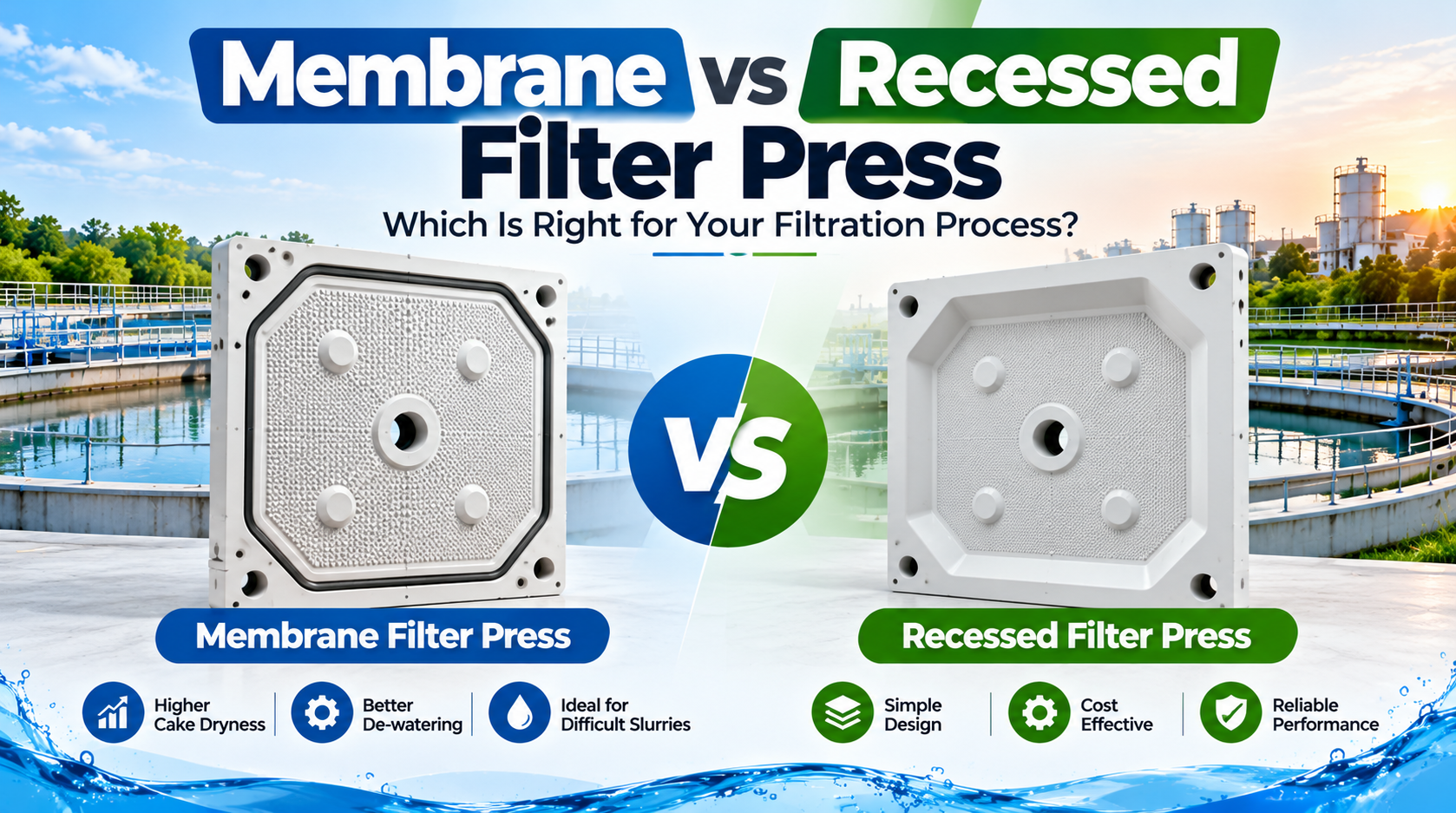
Membrane vs Recessed Filter Press: Which Is Right for Your Filtration Process?
When selecting an industrial filter press, one of the most important decisions is choosing between a membrane filter press and a recessed filter press. Both technologies are widely used for solid-liquid separation, sludge dewatering, wastewater treatment, chemical processing, mining, ceramics, pigments, and other industrial filtration applications.
However, they achieve dewatering differently.
A recessed filter press, also known as a recessed chamber filter press, primarily relies on slurry feed pressure to form and dewater the filter cake. A membrane filter press adds a secondary squeezing stage after the initial cake has formed, allowing additional liquid to be removed from the cake.
Understanding the membrane vs recessed filter press difference can help plant operators and engineers select equipment based on required cake moisture, filtration capacity, cycle time, operating cost, maintenance, and overall process economics.
Membrane vs Recessed Filter Press: Quick Answer
The main difference between a membrane and recessed filter press is the way the filter cake is dewatered after initial filtration.
A recessed filter press uses fixed recessed chamber plates and relies primarily on feed pressure for cake formation and dewatering.
A membrane filter press uses expandable membrane plates that compress the filter cake after initial filtration, helping remove additional liquid.
In simple terms:
Recessed Filter Press = Pressure Filtration
Membrane Filter Press = Pressure Filtration + Membrane Cake Squeezing
Because of the additional squeezing stage, a membrane filter press can be particularly useful when lower cake moisture or additional liquid recovery is an important process requirement.
To understand the basic filtration process first, read our guide on what a filter press is and how it works.
Membrane vs Recessed Filter Press at a Glance
Comparison Factor
Membrane Filter Press
Recessed Filter Press
Filtration principle
Pressure filtration + membrane squeezing
Pressure filtration
Plate design
Flexible/expandable membrane plates
Fixed recessed chamber plates
Secondary cake squeezing
Yes
No
Cake dewatering potential
Higher in suitable applications
Standard pressure dewatering
Cake moisture
Can achieve lower residual moisture depending on slurry
Depends mainly on feed pressure and slurry
Initial investment
Generally higher
Generally lower
System complexity
More complex
Relatively simple
Maintenance
Additional membrane components
Simpler plate configuration
Liquid recovery
Potentially higher
Standard
Cycle optimization
Can improve cycle performance for suitable slurries
Depends primarily on filtration characteristics
Best suited for
Applications requiring additional dewatering
General industrial filtration
Typical applications
Chemicals, minerals, wastewater, pigments, ceramics
Wastewater, chemicals, mining, ceramics, stone processing
The correct choice depends on the characteristics of the slurry and the objectives of the filtration process.
What Is a Recessed Filter Press?
A recessed filter press, commonly called a recessed chamber filter press, uses a series of filter plates containing recessed surfaces.
When two adjacent recessed plates are compressed together, their recessed areas create a chamber.
Filter cloth is installed over the plates, and slurry is pumped into these chambers under pressure.
During filtration:
- The filter press closes the plate pack.
- Slurry is pumped into the chambers.
- Liquid passes through the filter cloth.
- Suspended solids remain inside the chambers.
- Solids gradually accumulate and form a filter cake.
- Filtration continues until the desired endpoint is reached.
- Feed pressure is stopped and released.
- The plates are opened.
- The filter cake is discharged.
This straightforward filtration process makes recessed chamber filter presses suitable for many industrial applications.
For a deeper understanding of this technology, read our guide to chamber filter press systems and their industrial applications.
What Is a Membrane Filter Press?
A membrane filter press initially operates in a similar way to a recessed chamber filter press.
Slurry is pumped into the filtration chambers. The filter cloth retains solid particles while allowing liquid to pass through as filtrate.
The difference occurs after the initial filter cake has formed.
Instead of ending the filtration cycle at this stage, the membrane plates are pressurized according to the machine design.
The flexible membrane surface expands toward the filter cake and compresses it.
This additional mechanical squeezing action can force more liquid from the cake.
As a result, membrane filtration may provide:
- Additional cake dewatering
- Lower residual cake moisture
- Greater liquid recovery
- More consistent cake characteristics
- Reduced downstream drying requirements
- Potential cycle-time improvements for suitable applications
- Reduced wet-cake handling requirements
The exact results depend on slurry properties and operating conditions.
For more information about the technology behind this process, see our detailed guide explaining membrane filter plates and how membrane squeezing works.
How Does a Recessed Filter Press Work?
Understanding the filtration cycle makes the membrane vs recessed filter press comparison easier.
Stage 1: Plate Closing
The recessed plates are compressed together using the filter press closing mechanism.
This creates sealed chambers between adjacent plates.
Stage 2: Slurry Feeding
A feed pump transfers slurry into the chambers.
Pressure gradually increases as the chambers begin filling.
Stage 3: Filtration
The filter cloth retains suspended solid particles while allowing liquid to pass through.
The separated liquid exits the filter press as filtrate.
Stage 4: Cake Formation
Retained solids continue accumulating inside the chambers.
As the cake becomes thicker, resistance to liquid flow generally increases.
Stage 5: Filtration Completion
Once the required filtration endpoint has been reached, slurry feeding stops.
Stage 6: Cake Discharge
The press opens and the filter cakes are removed from between the plates.
This cycle can be highly effective when standard pressure filtration achieves the required cake characteristics.
How Does a Membrane Filter Press Work?
A membrane filter press follows many of the same initial stages but adds an important additional step.
Stage 1: Closing
The filter plate pack is securely closed.
Stage 2: Slurry Feeding
Slurry enters the filtration chambers under pressure.
Stage 3: Primary Filtration
Liquid passes through the filter cloth while solids remain inside the chambers.
Stage 4: Initial Cake Formation
Solids accumulate until the initial filter cake has formed.
Stage 5: Membrane Squeezing
The membrane is pressurized using the appropriate medium specified for the filter press design.
The membrane expands toward the cake.
This mechanically compresses the cake and helps force additional liquid through the filter cloth.
Stage 6: Pressure Release
After squeezing is complete, membrane pressure is released.
Stage 7: Cake Discharge
The plates open and the compressed cake is discharged.
This additional squeezing stage is the fundamental technological difference between membrane and recessed filtration.
Membrane vs Recessed Filter Press: 8 Key Differences
1. Filter Plate Design
The most obvious difference is the construction of the filter plates.
Recessed Filter Press
Recessed filter plates have fixed filtration surfaces.
Two adjacent plates form a chamber where the filter cake accumulates.
The plate surface itself does not expand during filtration.
Membrane Filter Press
Membrane plates incorporate a flexible or movable squeezing surface.
After the initial filter cake forms, this surface expands and compresses the cake.
Therefore:
Recessed plate → fixed chamber
Membrane plate → chamber + expandable squeezing surface
2. Cake Moisture
Cake moisture is often one of the biggest considerations when comparing the two technologies.
In a recessed chamber filter press, final moisture depends heavily on factors such as:
- Slurry characteristics
- Solids concentration
- Particle size
- Feed pressure
- Filter cloth
- Cake thickness
- Filtration time
- Temperature
- Cake compressibility
A membrane filter press adds mechanical cake compression.
The squeezing stage can remove additional liquid that may otherwise remain trapped inside the filter cake.
Therefore, membrane filtration generally offers greater potential for achieving lower cake moisture in suitable applications.
Actual moisture levels, however, should be determined through process evaluation or slurry testing rather than assumed from the equipment type alone.
3. Filtration Cycle
A recessed filter press relies primarily on slurry feed pressure throughout the filtration stage.
As the cake becomes thicker, resistance increases and filtrate flow generally decreases.
Continuing to pump for a long period may produce progressively smaller improvements in cake dryness.
A membrane press can transition from feed filtration to mechanical squeezing after the initial cake has formed.
For suitable slurries, this can help optimize the filtration cycle rather than depending entirely on prolonged feed pumping.
4. Initial Equipment Cost
A recessed chamber filter press normally has a simpler plate configuration.
Consequently, its initial investment can be lower than an equivalent membrane system.
A membrane filter press requires specialized membrane plates and associated squeezing components.
This usually increases the initial equipment investment.
However, purchase price alone should not determine which system is more economical.
5. Operating Economics
The better question is:
Which filter press produces the lowest total processing cost?
Consider:
- Equipment investment
- Energy consumption
- Labor
- Maintenance
- Filtration capacity
- Cake transportation
- Cake disposal
- Downstream drying
- Water or filtrate recovery
- Production throughput
- Product recovery
For example, if sludge disposal is charged according to weight, reducing the amount of water retained in the cake could potentially reduce disposal costs.
Similarly, a process requiring thermal drying may benefit economically from removing additional water mechanically before the drying stage.
6. Maintenance Requirements
Both systems require routine maintenance.
Common inspection areas include:
- Filter plates
- Filter cloth
- Hydraulic systems
- Feed pumps
- Valves
- Filtrate outlets
- Plate alignment
- Sealing surfaces
- Plate-shifting mechanisms
A membrane system also requires attention to its membrane components and squeezing system.
Correct operating pressure and appropriate preventive maintenance are particularly important.
A recessed chamber configuration is comparatively simpler because there is no expandable membrane squeezing surface.
7. Liquid Recovery
For industries where the filtrate is valuable or process-water recovery is important, additional cake dewatering may increase the amount of recoverable liquid.
Membrane squeezing can potentially recover more liquid from a formed cake than primary pressure filtration alone.
This may be useful in applications involving:
- Process water recovery
- Chemical recovery
- Product recovery
- Wastewater recycling
- Zero-liquid-discharge strategies
- High-value process liquids
Actual recovery depends on the slurry and process configuration.
8. Automation
Both membrane and recessed filter presses can be incorporated into automated filtration systems.
Automation may include:
- Automatic hydraulic closing
- Automatic slurry feeding
- Automatic plate shifting
- Cake discharge
- Filter cloth washing
- Drip trays
- Pneumatic or automated valves
- Conveyors
- Pump control
- PLC-based cycle management
Facilities requiring frequent filtration cycles can explore automatic filter press systems for reduced manual operation.
Advantages of a Membrane Filter Press
The potential advantages of membrane filtration include:
Lower Cake Moisture
The secondary squeezing stage can remove additional liquid from the filter cake.
Additional Liquid Recovery
Recovering more liquid may be valuable for certain industrial processes.
Reduced Downstream Drying
If filter cake must subsequently be dried, removing additional water mechanically may reduce the burden on the drying process.
Reduced Wet-Cake Handling
Lower moisture can reduce the amount of wet material requiring transportation, storage, or disposal.
Consistent Cake Compression
Membrane squeezing can help create more uniformly compressed cake in suitable applications.
Potential Cycle Optimization
For some slurries, mechanical squeezing can achieve the desired cake condition more efficiently than extending feed filtration.
Advantages of a Recessed Filter Press
A recessed chamber filter press also provides several important advantages.
Simpler Design
The fixed recessed plate configuration makes the system relatively straightforward.
Lower Initial Investment
Where membrane squeezing is unnecessary, a recessed filter press can provide an economical filtration solution.
Easier Maintenance
Fewer specialized squeezing components can simplify maintenance.
Wide Industrial Application
Recessed filter presses can handle a broad range of industrial slurries.
Reliable Batch Filtration
The technology is well suited to processes requiring consistent pressure filtration and cake formation.
Flexible Capacity
Different plate sizes, chamber depths, filtration areas, and press configurations can accommodate different processing requirements.
You can also explore the different types and ranges of filter press systems when comparing equipment configurations.
When Should You Choose a Membrane Filter Press?
A membrane filter press may be worth considering when:
- Lower filter-cake moisture is important
- Standard filtration leaves the cake too wet
- Sludge transportation costs are high
- Disposal cost depends on cake weight or volume
- Downstream drying consumes significant energy
- Additional process-liquid recovery is valuable
- Consistent cake characteristics are required
- Production requires optimized filtration cycles
- The slurry responds effectively to membrane squeezing
However, membrane filtration is not automatically the correct solution for every slurry.
The additional investment should provide a measurable technical or economic benefit.
When Should You Choose a Recessed Filter Press?
A recessed filter press may be more appropriate when:
- Standard pressure filtration achieves acceptable cake dryness
- The slurry filters relatively easily
- Lower capital investment is preferred
- A simple and reliable configuration is important
- Membrane squeezing would provide limited additional value
- Maintenance simplicity is a priority
- Conventional batch filtration meets production requirements
For many industrial processes, recessed chamber filtration provides an effective balance between filtration performance, simplicity, and cost.
Membrane vs Recessed Filter Press for Different Industries
Wastewater and Effluent Treatment
Filter presses are widely used to dewater sludge generated during wastewater and effluent treatment.
A recessed chamber press can be suitable where conventional sludge dewatering achieves the required result.
Membrane filtration can be considered when reducing cake moisture could lower sludge handling or disposal requirements.
Learn more about industrial applications of filter press systems, including wastewater, chemicals, mining, ceramics, pigments, and other sectors.
Chemical Industry
Chemical slurries can differ significantly in viscosity, particle characteristics, solids concentration, temperature, and chemical composition.
Either configuration may be appropriate depending on the process.
Where the filter cake contains valuable material or residual liquid, additional membrane squeezing may be useful.
Mining and Mineral Processing
Mining operations can generate large quantities of mineral slurry.
Important considerations can include:
- Water recovery
- Cake moisture
- Throughput
- Tailings handling
- Transportation
- Disposal
- Cycle time
Both membrane and recessed presses can be configured for mineral-processing applications depending on these requirements.
Ceramics
Ceramic manufacturing frequently involves slurry filtration before subsequent processing.
The desired cake moisture, consistency, capacity, and production cycle can influence whether recessed or membrane filtration is selected.
Pigments and Dyes
In pigment and dye manufacturing, filtration requirements may include product recovery, cake washing, filtrate quality, and moisture control.
The appropriate plate technology should therefore be selected based on the actual process.
Stone, Marble and Granite Processing
Stone-processing operations can generate wastewater containing suspended mineral particles.
Recessed chamber presses can provide effective sludge dewatering, while membrane squeezing may be considered when additional moisture reduction provides economic or handling benefits.
Is a Membrane Filter Press Better Than a Recessed Filter Press?
Not necessarily.
A membrane filter press provides an additional cake-squeezing capability, but that does not make it universally better.
If a recessed filter press already achieves the required:
- Cake moisture
- Filtrate clarity
- Processing capacity
- Cycle time
- Operating cost
then the additional complexity and investment of membrane filtration may not be necessary.
Conversely, if wet cake creates significant transportation, disposal, handling, or drying costs, membrane squeezing may provide substantial process advantages.
Therefore, the correct comparison is not simply:
“Which filter press is better?”
Instead, ask:
“Which filter press provides the required filtration performance at the best overall lifecycle cost for this particular slurry?”
Can Membrane and Recessed Plates Be Used Together?
Yes. Depending on the filter press design, some membrane filter presses use a combination of membrane plates and companion chamber plates.
This configuration can provide membrane squeezing while optimizing the overall plate arrangement.
However, existing filter presses should not automatically be converted simply by replacing recessed plates with membrane plates.
Compatibility must be evaluated based on factors such as:
- Plate dimensions
- Filter press frame
- Hydraulic closing capacity
- Operating pressure
- Squeeze pressure
- Port configuration
- Piping
- Controls
- Plate arrangement
For additional technical background, see our guide to membrane filter plates, their construction, benefits, and applications.
How to Choose Between Membrane and Recessed Filter Press
Before selecting a system, evaluate these seven factors.
1. Required Cake Moisture
Determine the maximum acceptable moisture level in the discharged filter cake.
If conventional pressure filtration achieves that target, recessed filtration may be sufficient.
If additional moisture reduction creates meaningful operational value, membrane filtration deserves consideration.
2. Slurry Characteristics
Evaluate:
- Solids concentration
- Particle size
- Particle-size distribution
- Viscosity
- Compressibility
- pH
- Temperature
- Chemical composition
- Specific gravity
Two slurries processed at similar pressures can behave very differently.
3. Required Processing Capacity
Determine the amount of slurry or dry solids that must be processed:
- Per hour
- Per cycle
- Per shift
- Per day
Filter press sizing should be based on actual production requirements.
4. Cake Disposal Cost
Calculate how much wet filter cake costs to transport and dispose of.
If moisture contributes significantly to disposal expenses, additional dewatering may provide an economic benefit.
5. Downstream Processing
Ask what happens to the cake after filtration.
Will it be:
- Disposed of?
- Transported?
- Thermally dried?
- Washed?
- Reprocessed?
- Sold as a product?
- Used as raw material?
The answer can substantially influence equipment selection.
6. Automation Requirements
Consider the number of filtration cycles performed each day and the amount of operator involvement required.
Higher-throughput plants may benefit from automated plate shifting, cake discharge, cloth washing, valves, pumps, and process controls.
7. Slurry Testing
Where possible, test the actual slurry before final equipment selection.
Testing can provide useful information about:
- Filtration rate
- Cake formation
- Cake moisture
- Filtrate clarity
- Cake release
- Cloth performance
- Cycle time
- Response to squeezing
Real process data is usually more valuable than selecting equipment from theoretical specifications alone.
Membrane vs Recessed Filter Press: Which Is More Economical?
A recessed filter press generally offers a lower initial equipment investment because of its simpler configuration.
But initial cost is only one part of the calculation.
A more useful comparison is:
Total Filtration Cost = Capital Cost + Energy + Labor + Maintenance + Cake Handling + Transportation + Disposal + Downstream Processing
Suppose membrane squeezing produces a sufficiently drier cake to reduce transportation, disposal, or thermal drying costs.
In that situation, a higher initial investment may potentially be offset by lower operating expenses.
Alternatively, if membrane squeezing provides little improvement for a particular slurry, a recessed chamber press may provide the more economical solution.
The decision should therefore be based on lifecycle economics rather than purchase price alone.
Frequently Asked Questions About Membrane vs Recessed Filter Press
What is the main difference between a membrane and recessed filter press?
A recessed filter press primarily uses slurry feed pressure to form and dewater the filter cake. A membrane filter press adds a secondary squeezing stage in which an expandable membrane compresses the formed cake and helps remove additional liquid.
Which produces a drier cake: membrane or recessed filter press?
A membrane filter press generally offers greater potential for lower cake moisture because of its additional mechanical squeezing stage. Actual moisture depends on slurry properties, operating pressure, filter cloth, cake characteristics, and process conditions.
Is a membrane filter press more expensive?
Membrane systems generally require higher initial investment because they use specialized membrane plates and additional squeezing components. However, lower cake moisture may provide lifecycle savings in applications with high disposal, transportation, or drying costs.
What is a recessed chamber filter press?
A recessed chamber filter press uses plates with fixed recessed surfaces. When adjacent plates are closed together, they form chambers where slurry enters and solids accumulate to create filter cakes.
Does a membrane filter press have a shorter cycle time?
It can in certain applications. Membrane squeezing can provide additional dewatering without relying entirely on extended feed filtration. However, actual cycle-time improvement depends on the slurry and process conditions.
Can membrane plates replace recessed plates?
Not automatically. The filter press frame, hydraulic system, pressure ratings, plate dimensions, piping, squeeze system, controls, and other components must be compatible with membrane operation.
Which filter press is better for wastewater sludge?
Both can be suitable. A recessed filter press may be sufficient for conventional sludge dewatering, while membrane filtration may be considered when lower cake moisture would improve handling or reduce disposal costs.
Which filter press requires less maintenance?
A recessed chamber filter press generally has a simpler plate configuration. Membrane presses require additional inspection and maintenance of the membrane and squeezing system.
How do I choose the right filter press?
Evaluate slurry properties, solids concentration, filtration capacity, required cake moisture, filtrate quality, cycle time, operating conditions, disposal costs, automation requirements, and lifecycle economics. Where practical, slurry testing should be conducted before final selection.
Conclusion: Membrane or Recessed Filter Press?
The membrane vs recessed filter press decision depends on the specific objectives of your filtration process.
A recessed filter press provides reliable pressure filtration with a relatively simple plate configuration and can be an economical choice when conventional dewatering achieves the required results.
A membrane filter press adds a secondary cake-squeezing stage, which can provide additional dewatering and lower residual cake moisture in suitable applications.
The right choice depends on more than cake dryness alone.
Slurry characteristics, production capacity, filter cloth, operating pressure, cycle time, maintenance, automation, liquid recovery, cake handling, disposal costs, and downstream processing should all be evaluated.
Panama Engineering provides filter press systems, filter plates, filter cloths, and filtration solutions for a range of industrial solid-liquid separation requirements.
Before selecting a filter press, evaluating the actual slurry and process conditions can help determine the appropriate plate configuration, filtration area, automation level, and equipment capacity.
Explore the complete range of filter press systems or learn more about filter press applications across different industries to continue your equipment evaluation.
Explore Filter Press Solutions
Continue your research with our filter press machines, filter press plates and technical enquiry pages.
Send Your Requirement